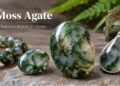


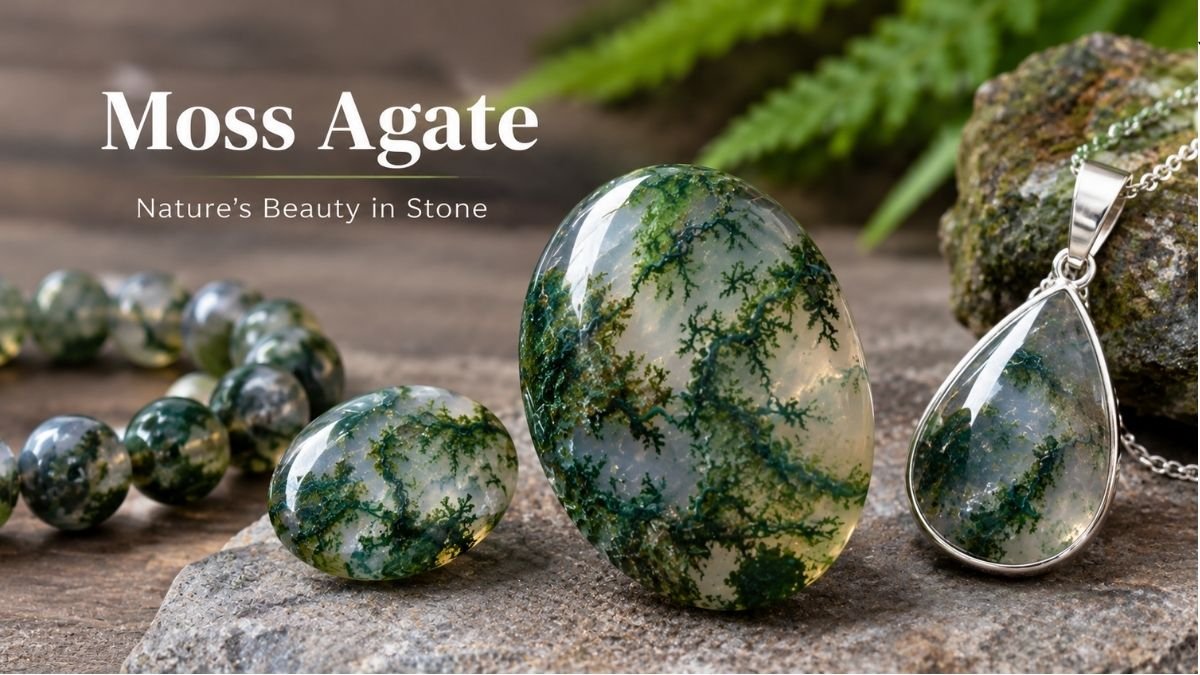
Moss Agate is a distinctive natural gemstone admired for its delicate green patterns that resemble moss, miniature forests, and underwater landscapes. Although its name suggests a connection to living plants, these remarkable formations are actually mineral inclusions enclosed within chalcedony, a fine-grained form of quartz. Each polished specimen reveals a different arrangement of colors and shapes, making the stone particularly appealing to gemstone collectors, jewelry designers, and people who appreciate natural materials.
Unlike gemstones valued primarily for intense color or exceptional transparency, Moss Agate is appreciated for its internal patterns and organic appearance. Its combination of geological interest, relative durability, and visual individuality has earned it a place in decorative stonework and contemporary jewelry.
Understanding Moss Agate goes beyond recognizing its appearance. Its mineral composition, formation, historical associations, and practical qualities explain why this unusual gemstone continues to attract attention.
What Is Moss Agate?
Moss Agate is a variety of chalcedony recognized by its moss-like mineral inclusions, which appear to float inside a transparent or translucent stone. Its name describes the appearance of these inclusions, not the presence of actual moss or fossilized vegetation.
Chalcedony consists of extremely fine intergrowths of silica minerals belonging to the quartz family. This structure gives Moss Agate its characteristic smooth appearance when polished, along with the durability associated with many quartz gemstones.
The green formations are commonly associated with minerals such as chlorite and hornblende. Different inclusion materials and chemical conditions can produce additional colors, including brown and reddish shades.
Interestingly, Moss Agate does not usually display the regular banding characteristic of many traditional agates. Gemological terminology therefore distinguishes typical banded agate from the unbanded, inclusion-rich chalcedony sold as Moss Agate.
This difference does not make its established trade name incorrect. It simply reflects how gemstone names can describe recognizable appearances rather than strict mineral classifications.
The Geological Formation of Moss Agate
Moss Agate forms through geological processes involving silica-rich fluids and mineral-bearing environments. As water carrying dissolved silica travels through openings in rock, silica can gradually accumulate and form chalcedony.
During this process, other mineral substances may become enclosed within the developing stone. Under suitable conditions, these materials create branching, threadlike, or cloud-shaped formations.
The resulting structures can resemble plant growth, even though they originate through inorganic geological processes. This resemblance is one of Moss Agate’s most fascinating characteristics.
Green inclusions often occur with chlorite or hornblende, while iron-related mineral changes can add brown or red coloration.
Formation conditions influence the size, distribution, and appearance of the inclusions. Some specimens contain delicate threads, while others display dense areas of green mineral material.
Because natural geological conditions differ between individual deposits, the resulting stones exhibit considerable visual variation.
Colors and Natural Patterns of Moss Agate
Although green is the color most strongly associated with Moss Agate, the gemstone can display several combinations of natural shades.
The surrounding chalcedony may appear colorless, white, pale gray, or softly translucent. Against this background, the mineral inclusions form patterns that can resemble ferns, branches, clouds, or miniature landscapes.
Some gemstones contain finely distributed green threads. Others feature larger clusters that create a stronger contrast with the surrounding stone.
Brown and reddish inclusions may also occur, especially where iron-bearing minerals have changed chemically.
One particularly appealing feature is the way light interacts with the gemstone. When a translucent specimen is held toward a light source, its inclusions may become more visible, revealing details that are less apparent under ordinary lighting.
Moss Agate’s beauty lies in this natural variation. Two stones can share similar colors and mineral compositions while displaying completely different internal designs.
Where Moss Agate Is Found
Moss Agate occurs in several parts of the world where suitable geological conditions have allowed chalcedony and its characteristic inclusions to form.
Documented sources include India, the United States, Australia, and parts of Europe, among other locations.
India has long been associated with agate production and gemstone cutting. Certain deposits in the northwestern United States also produce attractive moss-patterned chalcedony.
Historically, the gemstone has been associated with the name mocha stone, connected with Mocha in Yemen, an important historical trading location.
However, historical trade terminology should not be treated as proof of a particular specimen’s geographical origin.
A polished gemstone rarely reveals its exact source through appearance alone. Similar-looking material may come from different deposits, so reliable provenance depends on proper documentation.
For buyers interested in a specific country of origin, information from a knowledgeable supplier is generally more useful than assumptions based on color or pattern.
Physical Properties and Durability
Moss Agate belongs to the quartz family and has a Mohs hardness of approximately 6.5 to 7.
This hardness level provides reasonable resistance to everyday surface scratching, although it does not make the gemstone immune to damage.
Hardness and toughness describe different physical characteristics. Hardness measures resistance to scratching, while toughness concerns resistance to breaking, chipping, or fracturing.
Moss Agate can suit frequently worn jewelry, but exposed edges may still chip if struck against a hard surface.
Its translucent appearance and fine-grained structure make it particularly attractive when cut and polished to highlight the interior inclusions.
Gemstone cutters often choose shapes that offer a broad viewing surface, making the natural patterns the central feature of the finished piece.
Moss Agate in Modern Jewelry
Moss Agate is used in rings, necklaces, earrings, bracelets, and decorative accessories. Jewelry designers frequently select it for pieces inspired by natural landscapes and botanical forms.
One increasingly recognizable application is the Moss Agate engagement ring, which offers a visually distinctive alternative to more conventional gemstone designs.
Oval, pear, round, and cushion-shaped stones can all display attractive inclusions, depending on how the material is cut.
Cabochons, which have smooth, rounded surfaces, are another established cutting style for chalcedony.
Unlike highly transparent gemstones whose appeal may depend on brilliance, Moss Agate often benefits from cuts that emphasize its internal scenery.
For rings intended for frequent wear, protective settings can help reduce the risk of damage to vulnerable edges.
Its appeal comes from the relationship between natural pattern, craftsmanship, and personal visual preference rather than from a single universally accepted ideal appearance.
Symbolism and Traditional Meanings
Moss Agate has accumulated various symbolic associations through gemstone traditions and contemporary crystal-related practices.
It is often linked with nature, growth, renewal, and balance, reflecting the stone’s resemblance to vegetation and natural landscapes.
Some traditions associate it with prosperity or emotional steadiness. These interpretations are cultural or spiritual beliefs rather than scientifically established physical effects.
No reliable clinical evidence shows that wearing Moss Agate can treat illnesses, improve mental health, or produce specific medical outcomes.
Nevertheless, symbolic meaning can contribute to a gemstone’s appeal. A person may choose the gemstone because its patterns remind them of forests, gardens, or meaningful natural places.
Distinguishing symbolism from measurable gemstone properties helps readers appreciate traditional associations without confusing them with scientific findings.
How to Identify Genuine Moss Agate
Identifying genuine Moss Agate begins with examining its appearance, but visual inspection alone cannot establish authenticity in every case.
Natural specimens frequently contain irregular inclusions that vary in thickness, direction, and concentration. Their patterns generally appear integrated into the stone rather than printed on its surface.
A translucent background may help the observer appreciate the internal distribution of mineral inclusions.
However, variations in transparency and inclusion density are normal, and no single visual feature proves that a specimen is natural.
Imitation materials, dyed chalcedony, and other look-alike gemstones can complicate identification.
Some treated stones may also be genuine chalcedony, so the questions of mineral identity and treatment history should be considered separately.
Buyers should avoid destructive home scratch tests, which can damage both the gemstone and nearby surfaces.
For valuable purchases, a qualified gemologist’s assessment provides stronger evidence than appearance-based assumptions.
Factors That Influence Moss Agate Value
The commercial appeal of Moss Agate depends on several interacting qualities, especially its natural pattern, overall appearance, cutting, and condition.
A stone with an attractive arrangement of clearly visible inclusions may appeal more strongly to a buyer than one with crowded or poorly defined markings.
Transparency also contributes to its appearance. A relatively clear background can make the interior formations easier to appreciate, although milky specimens can be equally attractive when their patterns are distinctive.
Polishing quality, cut symmetry, and the absence of significant surface damage are additional considerations.
Size matters, but it should not be evaluated independently of visual quality.
Because the gemstone’s patterns are highly individual, pricing is less standardized than for some major precious gemstones. Retail presentation, jewelry settings, craftsmanship, and documented provenance may also influence the final selling price.
No single universally accepted price applies to every Moss Agate specimen.
Cleaning and Caring for Moss Agate
Proper maintenance helps preserve the appearance and condition of Moss Agate jewelry.
For ordinary cleaning, use lukewarm water, mild soap, and a soft cloth or gentle brush. Carefully remove accumulated dirt, then rinse and dry the jewelry thoroughly.
Avoid exposing the stone to harsh household cleaning chemicals or unnecessary mechanical pressure.
Ultrasonic and steam-cleaning systems are best avoided unless a qualified professional has confirmed that the particular jewelry piece can tolerate them.
Store Moss Agate separately from harder gemstones that could scratch its polished surface.
Rings should be removed before activities involving significant impact, abrasive materials, or heavy physical work.
For translucent settings, keeping the underside of the stone clean can be especially useful because accumulated debris may reduce the visibility of the internal patterns.
With sensible handling, Moss Agate jewelry can retain its natural appeal for many years.
Conclusion
Moss Agate is an exceptional example of how geological processes can produce patterns that resemble the natural world. Its green mineral inclusions, translucent chalcedony background, and wide variety of internal designs distinguish it from many other decorative gemstones.
Beyond its appearance, the stone offers an interesting combination of geological history, cultural symbolism, and practical jewelry applications. Understanding its composition, formation, physical properties, and care requirements helps collectors and buyers make informed decisions.
Whether appreciated as a polished mineral specimen, a pendant, or a distinctive ring, Moss Agate remains a compelling gemstone whose natural beauty comes from the remarkable patterns formed within the Earth.
(FAQs)
1. Is Moss Agate a real natural gemstone?
Yes. Moss Agate is a recognized gemstone material belonging to the chalcedony family. Its distinctive patterns are formed by mineral inclusions rather than living moss or plant fossils.
2. Is Moss Agate suitable for everyday jewelry?
Moss Agate has a hardness of approximately 6.5 to 7 on the Mohs scale, making it suitable for many jewelry applications. However, rings and other frequently worn pieces should be protected from strong impacts.
3. What makes Moss Agate different from ordinary agate?
Traditional agates commonly feature colored bands, while Moss Agate is best known for irregular mineral inclusions that resemble moss or vegetation. It generally lacks the characteristic banding of ordinary agate.
4. Is green Moss Agate more valuable than other colors?
Not necessarily. Green is the most recognizable color, but a gemstone’s appeal also depends on its pattern, translucency, condition, and cutting quality. Attractive specimens containing several natural colors may also be desirable.
5. Does Moss Agate have scientifically proven healing properties?
No clinical evidence establishes Moss Agate as a medical treatment. Beliefs about healing, prosperity, or emotional balance belong to traditional and spiritual interpretations rather than demonstrated therapeutic properties.