


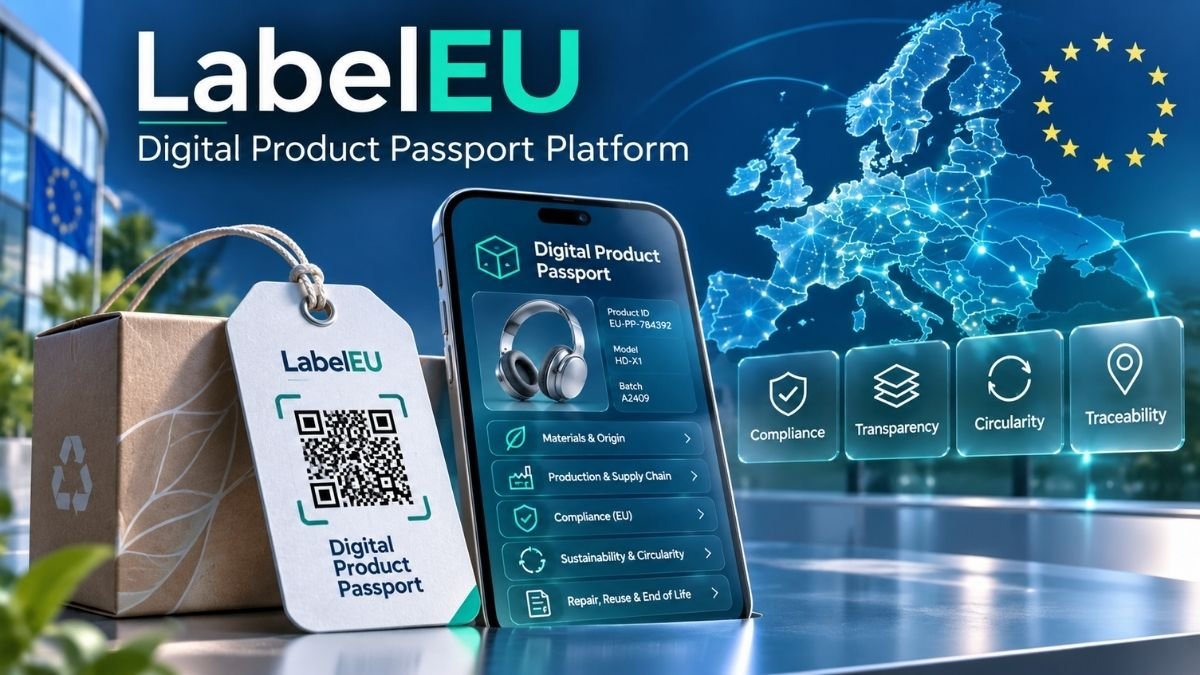
LabelEU is a software platform that helps businesses prepare, organize, and manage Digital Product Passports for products entering the European market. As the European Union develops new rules on sustainability, traceability, and product information, services like LabelEU are attracting interest from manufacturers, retailers, importers, and compliance professionals.
Unlike a government certification authority, LabelEU provides digital tools that businesses can use to document product information, prepare QR-linked records, and manage labeling workflows. Its services relate to the European Union’s Ecodesign for Sustainable Products Regulation and other product-specific legislation.
Understanding LabelEU requires separating what the platform currently offers from what future legislation may demand. Its published features, pricing information, and regulatory references provide a useful starting point for evaluating the service.
What Is LabelEU?
LabelEU is a commercial software service focused on Digital Product Passports (DPPs).
A Digital Product Passport is a structured electronic record containing information about a physical product. Depending on applicable legislation, this may include product identification, materials, manufacturing information, environmental characteristics, certifications, and instructions concerning repair or disposal.
The purpose is to make relevant product information easier to access and manage throughout a product’s lifecycle.
LabelEU aims to simplify the technical work involved in preparing these records. Rather than developing their own systems, businesses can use its guided forms, product-information fields, and label-design tools.
The distinction between providing software and certifying compliance is essential. LabelEU does not itself act as an EU regulator, and using its platform does not automatically establish that a product satisfies European legal requirements.
Background and Development of LabelEU
What Is Publicly Known About Its Origins?
LabelEU presents itself as a technology service responding to growing European requirements for structured product information.
Its publicly accessible materials explain the platform’s features, regulatory focus, and intended commercial model. However, the reviewed official information does not establish a verified founder biography, precise launch history, or comprehensive company ownership background.
Those details should not be reconstructed from assumptions.
Instead, the platform’s relevant public identity is defined by its technology and commercial purpose: helping businesses manage information that may be required under current or future product legislation.
Why the Platform Is Relevant
European product regulation increasingly emphasizes reliable information about what products contain, where they originate, and how they can be handled after use.
Businesses may hold these details in spreadsheets, supplier documents, technical files, or internal databases.
Digital Product Passport systems attempt to organize that information into records that authorized users can access more consistently.
LabelEU operates within this emerging software category.
LabelEU and European Union Regulations
Understanding the Ecodesign Framework
One of the principal regulatory frameworks associated with LabelEU is Regulation (EU) 2024/1781, known as the Ecodesign for Sustainable Products Regulation, or ESPR.
The regulation establishes a framework for future product-specific sustainability and information requirements.
Its Digital Product Passport provisions are particularly relevant because they establish principles for accessible, structured, and interoperable product information.
However, ESPR does not make Digital Product Passports universally mandatory for every product simply because the regulation exists.
Specific obligations depend on further rules applying to the relevant product category.
Businesses therefore need to distinguish between preparing for future requirements and satisfying obligations already in force.
Is LabelEU Connected to the European Commission?
LabelEU’s software is designed around EU regulatory requirements, but that does not make it an official European Commission service.
The company describes a commercial platform offering product passport preparation and management.
The reviewed sources provide no verified basis to describe it as an EU-owned organization, government certification authority, or official regulator.
That distinction matters when businesses assess compliance claims.
How Does LabelEU Work?
LabelEU describes a workflow built around organizing information, preparing digital records, and creating product labels.
Entering Product Information
Users can enter product information through structured forms.
Depending on the category, relevant information may include product names, identifying numbers, composition, origin, environmental details, and available compliance documentation.
Some data can also be imported from existing business records.
The software’s usefulness depends heavily on the accuracy and completeness of the information supplied.
Preparing a Digital Product Passport
Once product information has been entered, the platform can organize it into a digital passport record.
Such records are intended to present information in a format that is easier for consumers, businesses, and other authorized parties to access.
The exact contents required by law depend on the product category and the applicable legislation.
Labels and QR Codes
LabelEU advertises a label-design system and QR-code functionality.
A QR code can connect a physical product or its packaging to a digital information page.
This helps businesses make information accessible without printing extensive documentation directly on a label.
Nevertheless, a functional QR code does not establish that the information behind it is legally sufficient or accurate.
Main Features of LabelEU
Product Information Management
The platform offers category-oriented fields to help businesses assemble structured product records.
This may be particularly useful where different suppliers provide information in inconsistent formats.
Bulk Import Options
LabelEU advertises CSV, Excel, and Shopify-related importing.
For businesses with extensive product catalogs, importing existing information could reduce repetitive manual entry.
Users should confirm compatibility with their specific files and workflows.
Custom Label Design
Its published capabilities include customizable product labels, branding options, and PDF exports.
These functions connect product-information management with the practical work of preparing packaging or printable labels.
Team Collaboration and Integrations
The platform’s published pricing information also describes team collaboration and REST API access.
These capabilities are intended to support organizations that need multiple employees or connected systems to manage product records.
Feature availability should be checked before businesses make operational commitments.
Digital Product Passport Requirements and Key Dates
Not every industry has the same compliance timeline.
Product Category Regulatory Position
Electric vehicle and qualifying industrial batteries Battery passport requirements begin February 18, 2027
Light means of transport batteries Battery passport requirements begin February 18, 2027
Toys New Toy Safety Regulation generally applies from August 1, 2030
Textiles Product-specific ESPR passport requirements remain dependent on further legislation
Furniture Product-specific ESPR passport requirements remain dependent on further legislation
These dates explain why some manufacturers face more immediate preparation needs than others.
For example, Article 77 of the EU Battery Regulation establishes passport obligations from February 18, 2027 for specified battery categories.
Other products follow different legal pathways.
Businesses should consult the applicable legislation rather than assume one universal deadline.
LabelEU Pricing and Availability
LabelEU advertises free access for preparing up to three draft product passports.
Its published pricing page also displays proposed commercial packages.
PackagePassport CreditsListed Price
Starter 5 €50
Growth 25 €199
Scale 100 €699
As of November 2026, these are proposed prices, not currently purchasable packages.
The platform’s official pricing page states that passport packs are not on sale.
Consequently, businesses should not interpret the displayed prices as active checkout offers.
Users can explore draft functionality, while commercial publishing availability remains an important consideration.
Is LabelEU Legitimate and Reliable?
LabelEU maintains an accessible website describing its services, privacy practices, pricing intentions, and regulatory approach.
These public materials help prospective customers understand what the service claims to offer.
However, a website and privacy policy do not, by themselves, establish the reliability of every advertised feature.
Businesses should distinguish three separate questions.
First, does the software provide the functionality required for their products?
Second, can it adequately support the technical and data-management requirements relevant to their industry?
Third, are its security, hosting, export, and support arrangements suitable for their operations?
Answering these questions may require demonstrations, contractual review, testing, and independent technical assessment.
No software platform should be treated as a substitute for a business’s own legal and product-compliance responsibilities.
What Businesses Should Consider Before Using LabelEU
Businesses considering LabelEU should start by identifying the specific regulations that apply to their products.
They should then assess the quality of their existing product information.
A digital record cannot compensate for missing supplier documentation, incorrect material declarations, or unsupported environmental claims.
Data portability also deserves attention. Product information may need to remain available for years, sometimes beyond the relationship with an individual software provider.
Organizations should understand their rights to export records, maintain working QR-code destinations, and preserve required information.
Security and access permissions are equally relevant, particularly where product documentation contains commercially sensitive information.
The most valuable Digital Product Passport system is not necessarily the one with the largest feature list. It is the one that can reliably support accurate information, appropriate access, and long-term regulatory obligations.
Final Thoughts
LabelEU represents a software-led approach to managing product information as European regulatory requirements evolve.
Its advertised tools combine Digital Product Passport preparation, structured product records, QR codes, labeling, and integration options.
For businesses evaluating the platform, the central questions concern data accuracy, regulatory suitability, actual feature availability, and long-term reliability.
LabelEU is best understood as a potential technology provider within the wider Digital Product Passport ecosystem, not as an official certification authority or a guarantee of legal compliance.
(FAQs)
1. What is LabelEU used for?
LabelEU is used to prepare and manage digital product information, including Digital Product Passports, QR-linked records, and product labels.
2. Is LabelEU an official European Union organization?
No. LabelEU presents itself as a commercial software platform, not an official EU regulatory authority or certification body.
3. Who founded LabelEU?
The reviewed official public sources do not establish a verified founder identity. A founder’s name should not be presented without reliable confirmation.
4. Is LabelEU free to use?
The platform advertises three free draft passports. Its proposed paid passport packages are not currently offered for purchase.
5. Does LabelEU guarantee EU product compliance?
No. Software can help businesses organize information and prepare documentation, but legal compliance depends on the product, applicable regulations, and accuracy of the underlying records.