

CDX Learning is a specialist educational platform that provides interactive learning materials, technical training resources, and digital instructional tools for automotive and heavy-equipment education. Formerly known as CDX Learning Systems, the organization helps students, instructors, and educational institutions build the practical knowledge needed for careers in vehicle maintenance, repair, and related technical industries.
Unlike general online learning platforms that cover numerous academic subjects, CDX Learning concentrates on skilled technician education. Its resources combine textbooks, digital lessons, assessments, illustrations, and practical learning activities to help learners understand complex mechanical systems.
The platform dates back to 1994 and operates as part of Jones & Bartlett Learning. Its educational materials serve automotive training programs, vocational schools, colleges, and professional learning environments.
This article explores CDX Learning’s background, development, training programs, educational technology, business structure, and relevance to technical education in 2026.
From Australian Beginnings to an International Training Platform
CDX Learning Systems began in Brisbane, Australia, in 1994. The organization initially operated as CDX Global and developed educational materials to improve automotive technician training.
During the 1990s, automotive education faced a significant instructional challenge. Students needed to understand increasingly complicated mechanical and electrical systems, yet many traditional learning environments depended heavily on printed manuals and classroom demonstrations.
Technical subjects such as engine operation, transmission systems, electrical circuits, and vehicle diagnostics can be difficult to understand through written explanations alone.
CDX addressed this problem by developing multimedia educational resources that could visually demonstrate technical processes while supporting conventional instruction.
Its early development reflected a broader change in vocational education: the growing use of digital technology to explain practical skills.
Although the organization originated in Australia, its educational products eventually reached international markets.
A historical institutional description published by Palomar College identifies CDX Automotive as a provider that expanded to serve educational institutions across six continents.
This international development helped establish CDX as a recognizable name in automotive training.
An important milestone occurred in 2009, when Jones & Bartlett Learning acquired CDX Automotive.
The acquisition connected the specialist training platform to a larger educational publisher.
This relationship provided a framework for continued curriculum development, digital learning resources, and educational distribution.
The CDX name has remained associated with interactive technical education rather than conventional academic publishing alone.
How CDX Learning Developed Its Automotive Education Programs
CDX Learning’s professional development has closely followed changes in automotive technology.
Earlier automotive training focused extensively on mechanical components, conventional engines, braking systems, and standard maintenance procedures.
Modern vehicles require technicians to understand considerably more.
Electronic control systems, advanced diagnostic equipment, increasingly sophisticated electrical architecture, and alternative powertrains have changed what automotive professionals are expected to know.
CDX Learning’s educational resources address this need through structured instructional programs.
One of its principal curriculum collections is Fundamentals of Automotive Technology.
This program provides a foundation for understanding automotive systems, service procedures, diagnostic methods, and workshop practices.
The organization also offers learning materials for maintenance and light repair, advanced automobile service, diesel technology, and heavy commercial vehicles.
Rather than functioning as a single online course, CDX Learning operates through a collection of related educational products.
These materials are designed to support different levels of technical instruction.
A beginner studying routine vehicle maintenance may require a different curriculum from an experienced learner preparing for advanced diagnostic responsibilities.
The CDX approach lets educational institutions choose resources that match their teaching objectives.
This flexibility matters in vocational education, where program structures, equipment availability, and student experience can vary widely.
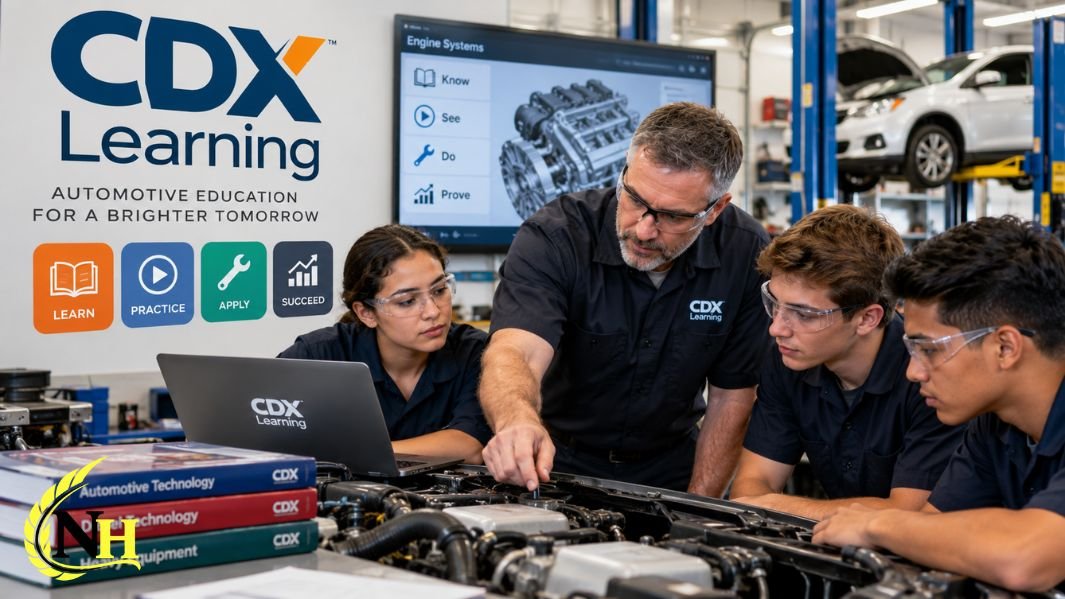
Understanding the Know-See-Do-Prove Learning Method
A distinctive feature of CDX Learning is its Know-See-Do-Prove instructional model.
This framework links theoretical understanding with visual instruction, hands-on practice, and assessment.
The approach reflects the practical nature of automotive education.
Students cannot develop full technician competence simply by memorizing component names or reading repair-procedure descriptions.
They must understand why systems operate the way they do and learn how to apply that knowledge.
The four stages provide a structured way to develop those abilities.
Know focuses on understanding essential information.
Students study mechanical principles, component functions, safety requirements, and technical terminology.
See introduces visual learning.
Illustrations, animations, videos, and demonstrations help explain processes that may be difficult to observe directly.
For example, an animation can show how internal engine components move without requiring an engine to be disassembled.
Do connects classroom knowledge with practical activities.
Learners apply what they have studied through exercises, workshop tasks, and technical procedures.
Prove involves demonstrating understanding or competence through assessments and other evaluation methods.
This final stage helps instructors identify whether students have achieved the intended learning outcomes.
The model’s strength lies in connecting several types of learning rather than treating theoretical knowledge and practical experience as unrelated activities.
However, digital learning resources remain a supplement to appropriate supervised workshop experience, particularly where safety-critical repair procedures are involved.
Automotive Technology and Vehicle Maintenance Courses
Automotive education remains central to CDX Learning’s product range.
The platform provides instructional materials covering fundamental vehicle systems and maintenance procedures.
Its Fundamentals of Automotive Technology resources support learners studying the principles of automobile operation and service.
Subjects can include engine systems, electrical fundamentals, braking, steering, suspension, and diagnostic procedures.
The exact topics depend on the selected textbook edition and course package.
Another important program is Maintenance and Light Repair.
This area focuses on foundational service tasks and technical knowledge relevant to entry-level automotive training.
Students may encounter subjects such as routine inspections, basic maintenance procedures, and introductory diagnostic concepts.
CDX also provides resources associated with Master Automobile Service Technician education.
These materials address more advanced technical knowledge within automotive service training.
The availability of different curriculum levels lets instructors build programs that progress from introductory concepts to more demanding technical work.
CDX Learning also lists educational resources addressing light-duty hybrid and electric vehicles.
Their inclusion reflects the growing importance of electrical knowledge and alternative vehicle technologies in modern automotive education.
For prospective students, the right program depends on their education, qualifications, goals, and existing technical experience.
Diesel Engines, Heavy Trucks, and Mobile Equipment Training
CDX Learning’s curriculum extends beyond passenger vehicles.
The organization also develops educational resources for medium- and heavy-duty vehicles, diesel engines, and mobile heavy equipment.
These areas require specialized technical knowledge because commercial and industrial machines operate under different conditions from ordinary passenger cars.
Heavy-duty diesel engines, for example, power vehicles and equipment designed for demanding operating environments.
Technicians working in these fields must understand engine performance, maintenance requirements, mechanical systems, and diagnostic procedures.
CDX Learning provides resources specifically for medium- and heavy-duty diesel engines and commercial vehicle systems.
The platform also includes mobile heavy equipment training materials.
These resources support educational programs that prepare students to work with industrial and construction machinery.
The practical requirements of these occupations make structured training especially valuable.
Mechanical errors can create operational problems, expensive equipment damage, or serious safety risks.
Educational materials that explain system operation and diagnostic reasoning can therefore support more effective technician preparation.
Nevertheless, completing online lessons alone should not be mistaken for professional certification or full workplace competence.
Those outcomes depend on the requirements of the relevant qualification or employer.
Digital Learning Tools and Instructor Resources
Digital learning is an important component of the CDX educational model.
The platform combines traditional instructional materials with online resources that support classroom teaching and independent study.
Depending on the product, these resources can include digital reading materials, interactive activities, illustrations, videos, quizzes, and assessment tools.
For students, digital access can make it easier to revisit difficult subjects outside scheduled classroom hours.
A learner struggling to understand a mechanical system may benefit from reviewing an animation or repeating a practice assessment.
For instructors, online resources can support lesson planning, student evaluation, and course administration.
CDX has also provided digital learning environments through which students and educators access assigned course materials.
Its website directs users toward account-based course access and product-specific resources.
The availability of these tools does not mean every CDX product includes identical digital features.
Access arrangements, course content, and included resources vary according to the selected package.
Students should therefore confirm their required textbook edition, access code, and course materials with their educational institution before purchasing.
CDX Learning’s Business Model and Financial Information
Unlike a publicly traded company that releases detailed financial statements, CDX Learning does not provide a separately verified public valuation in the sources reviewed for this article.
Consequently, CDX Learning’s exact net worth, annual Revenue, and operating profit cannot be reliably stated.
Its documented commercial activities involve educational publishing, digital courseware, textbooks, and related instructional resources.
These products are supplied to individual learners and educational organizations.
The platform operates as part of Jones & Bartlett Learning, meaning its financial activities should not automatically be treated as those of an independent publicly listed business.
The distinction between Revenue and valuation is important.
Revenue represents income generated through business operations before the relevant expenses are deducted.
Profit reflects earnings after applicable costs.
Business valuation concerns an organization’s estimated economic value.
These figures are not interchangeable.
Without reliable financial disclosures, assigning a numerical valuation to CDX Learning would be speculative.
Its established product catalogue and educational relationships demonstrate ongoing commercial activity, but they do not establish a particular level of profitability.
Educational Partnerships and Industry Relevance
CDX Learning serves a specialized market within technical education.
Its audience includes secondary schools, vocational institutions, colleges, and organizations involved in technician development.
Educational institutions use specialist curriculum materials to help students progress from basic technical concepts toward occupational competence.
CDX’s resources are relevant because they combine technical subject matter with classroom-ready instructional tools.
The organization has also identified connections with automotive education and technician-training communities.
Its historical product materials reference support for organizations such as the ASE Education Foundation and the North American Council of Automotive Teachers (NACAT).
These associations provide context for the educational environment in which CDX operates.
However, an organization’s support for an industry body should not be interpreted as proof that every individual course automatically awards certification or accreditation.
Students seeking recognised qualifications must confirm the requirements of their school, training programme, and relevant certification authority.
CDX Learning’s wider significance lies in its contribution to the delivery of structured technical knowledge.
By providing specialized educational content, it supports instructors who prepare learners for practical automotive occupations.
The Benefits and Limitations of CDX Learning
CDX Learning offers several practical advantages for automotive education.
Its specialized curriculum is designed around technician training rather than general academic learning.
This focus allows technical subjects to be presented through a combination of written explanations, visual demonstrations, and structured activities.
Another benefit is access to materials for different vehicle categories.
Students interested in passenger vehicles, diesel engines, or heavy equipment can explore resources relevant to their intended area of study.
The platform’s instructional model also encourages students to connect knowledge to practical application.
For instructors, prepared teaching materials and assessment resources may reduce the time required to develop every classroom activity independently.
However, CDX Learning has limitations.
Access to some resources requires purchasing the relevant product or obtaining an authorized course code.
The platform is also primarily intended for technical education, making it less suitable for learners seeking unrelated academic subjects.
Most importantly, digital instruction cannot completely replace supervised practical training.
Automotive repair requires appropriate tools, safe working conditions, and experience handling physical equipment.
The effectiveness of any learning platform also depends on instruction quality and the student’s engagement with the material.
CDX should therefore be understood as an educational resource within a broader training process.
CDX Learning in 2026: Its Place in Modern Technical Education
As of October 2026, CDX Learning Systems remains an active provider of educational resources for automotive and skilled technicians.
Its official product catalog continues to feature automotive technology, maintenance and light repair, diesel engines, commercial vehicle systems, and mobile heavy equipment.
These areas remain relevant as the transportation and equipment industries continue to develop.
The increasing complexity of vehicle electronics and diagnostic systems creates an ongoing need for technical education that connects theoretical understanding with practical skills.
CDX Learning’s established curriculum model meets this need.
Its history also shows how specialist vocational training providers have adapted to digital instruction.
Beginning as an automotive educational organization in Australia, CDX expanded internationally and became part of a larger educational publishing business.
It is not a conventional university or independent professional licensing authority.
Instead, it provides curriculum materials and learning technology that educational institutions can incorporate into their training programs.
For students considering automotive careers, CDX Learning can be a useful source of structured educational content when paired with appropriate instruction and practical experience.
For instructors, its value lies in the combination of technical subject matter, visual learning resources, and assessment support.
The platform’s continued relevance ultimately depends on the accuracy of its educational content, its responsiveness to technological developments, and its ability to support effective technician training.
(FAQs)
1. What is CDX Learning?
CDX Learning is an educational platform specializing in automotive and skilled-technician training. It provides textbooks, online courses, multimedia resources, and assessment materials for students and instructors.
2. Who owns CDX Learning Systems?
CDX Learning Systems operates as a division of Jones & Bartlett Learning, which acquired CDX Automotive in 2009.
3. Is CDX Learning suitable for beginners?
Yes. CDX offers introductory automotive education materials, including Fundamentals of Automotive Technology and Maintenance and Light Repair. Students should select resources appropriate to their training program.
4. What is CDX Learning’s net worth in 2026?
CDX Learning’s independent business valuation and annual Revenue are not reliably disclosed in the publicly available information reviewed. Any unsupported numerical estimate should be treated cautiously.
5. What courses does CDX Learning offer in 2026?
CDX Learning provides resources covering automotive technology, maintenance and light repair, master automobile service technician training, diesel engines, medium/heavy-duty commercial vehicles, and mobile heavy equipment.