


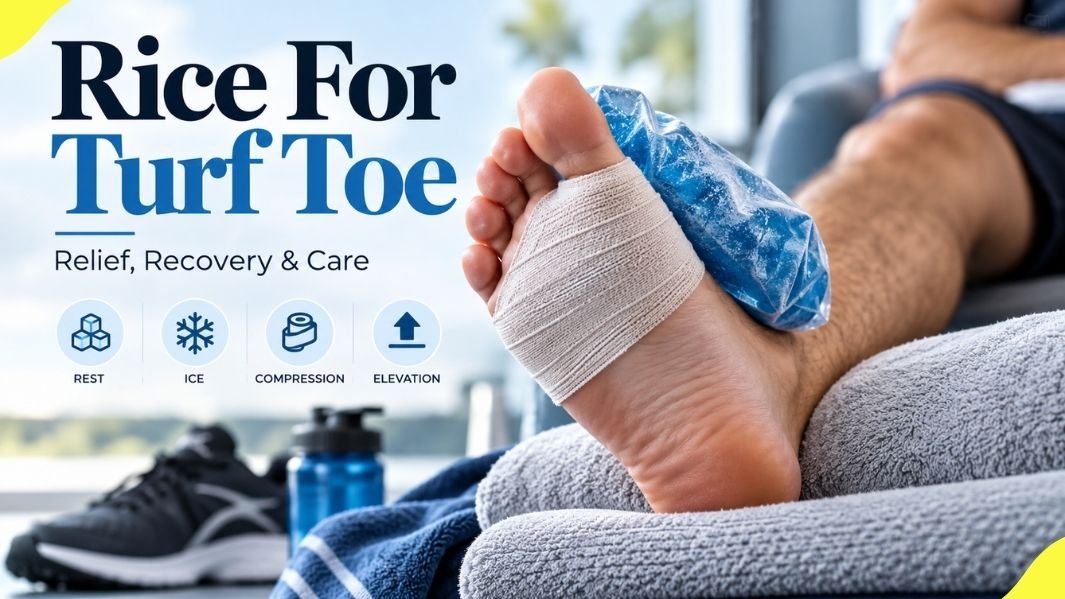
RICE for Turf Toe is a widely recognized first-aid approach for managing the pain and swelling associated with injuries to the big toe joint. The acronym RICE stands for Rest, Ice, Compression, and Elevation. These four measures can provide short-term relief after a turf toe injury, especially when the supporting ligaments and soft tissues are stretched or partially torn.
Although turf toe is frequently associated with American football, it can affect runners, footballers, dancers, gymnasts, and anyone whose big toe bends upward beyond its normal range. The injury may seem minor at first, but more serious cases can disrupt walking, balance, and athletic performance.
Knowing how to apply RICE correctly helps, but understanding its limitations matters as much. Appropriate treatment depends on injury severity, joint stability, and how symptoms develop during recovery.
This article explains how RICE works for turf toe, the different injury grades, safe treatment techniques, expected recovery periods, and the warning signs that require professional medical assessment.
Understanding Turf Toe and Why the Big Toe Becomes Injured
Turf toe is a sprain affecting the metatarsophalangeal joint, commonly called the MTP joint. This large joint connects the big toe to the first metatarsal bone of the foot. It plays an essential role in walking, running, jumping, and pushing the body forward.
The joint is stabilized by several structures, including the plantar plate, collateral ligaments, tendons, and small sesamoid bones. Together, these tissues support the joint and prevent excessive movement.
A turf toe injury typically occurs when the front of the foot stays planted while the heel rises and the big toe bends sharply upward. This movement, known as hyperextension, places excessive stress on the supporting tissues.
The name originated from the association between these injuries and American football played on artificial turf. Hard playing surfaces and flexible athletic shoes can increase the forces involved, although the injury isn’t limited to artificial fields.
Athletes may experience turf toe during sprinting, tackling, sudden directional changes, or jumping. Dancers and other physically active people can develop similar injuries through repeated pressure on the forefoot.
Pain is usually concentrated around the base of the big toe. Some people notice swelling almost immediately, while others develop increasing tenderness and stiffness in the hours after the injury.
Because the big toe helps transfer body weight during movement, even relatively mild damage can affect normal walking mechanics. This is why early recognition, appropriate protection, and a gradual return to activity are important.
The Three Grades of Turf Toe and Their Symptoms
Healthcare professionals commonly classify turf toe into three grades according to the extent of damage to the supporting soft tissues. This classification helps guide treatment decisions and estimate recovery needs.
Grade 1: Mild Stretching of the Joint
A Grade 1 injury involves stretching of the plantar supporting structures without a major tear. The affected joint may feel tender, with mild swelling.
Walking is often possible, although pushing off the injured foot may cause discomfort. Many mild injuries improve with protection, symptom management, and temporary activity modifications.
Grade 2: Partial Damage to Supporting Tissues
Grade 2 turf toe involves a partial tear of the supporting structures. Pain is more noticeable, and bruising, swelling, and restricted movement are common.
Athletes may struggle to run, jump, or change direction. These injuries frequently require more protection than RICE alone, sometimes including supportive taping, rigid footwear, or a walking boot prescribed by a clinician.
Grade 3: Severe Ligament or Plantar Plate Injury
Grade 3 injuries involve complete disruption of important supporting tissues. Severe pain, extensive bruising, significant swelling, and difficulty moving or bearing weight on the toe may occur.
The joint can become unstable, and the sesamoid bones or joint surfaces may be damaged.
These injuries need prompt medical evaluation. Some require prolonged immobilization, specialist rehabilitation, or surgical treatment.
You cannot reliably determine the severity of turf toe from pain alone. A clinical examination and, when appropriate, imaging are needed to determine the injury’s extent.
Applying RICE for Turf Toe: Four Essential Steps
The RICE method for turf toe focuses on managing immediate symptoms and protecting injured tissues from additional stress. It is most useful in the initial response to an injury, not as a complete rehabilitation program.
Rest: Reduce Pressure on the Injured Joint
First, stop the activity that caused the injury. Continuing to sprint, jump, or repeatedly push off the affected toe may worsen tissue damage.
Rest does not necessarily mean remaining completely inactive for an extended period. Instead, it involves avoiding movements that place unnecessary stress on the injured joint.
Depending on symptoms, a healthcare professional may recommend reduced weight-bearing, supportive footwear, crutches, or temporary immobilization.
Once the injury is stable, carefully controlled movement can support recovery. Prolonged unnecessary immobilization may contribute to stiffness.
Ice: Manage Pain With Short Cooling Sessions
Cold therapy can temporarily reduce pain by numbing the affected area. It may also help manage swelling during the early stages of injury.
Place a cold pack inside a thin towel rather than directly against the skin. Apply it for approximately 10–20 minutes per session, avoiding prolonged exposure.
Recommendations differ on how frequently and for how many days ice should be used. Contemporary guidance increasingly favors limited use for immediate symptom relief rather than repeated icing throughout the entire healing process.
Stop if the skin becomes unusually painful, excessively numb, or discolored. People with impaired circulation or reduced skin sensation should seek professional advice before using cold therapy.
Compression: Provide Gentle Support Without Restricting Circulation
Compression involves applying gentle pressure around the affected area, usually using an elastic bandage or an appropriate support.
It may help control significant swelling, although evidence for its benefits in every minor soft-tissue injury is limited.
A bandage should feel supportive, not restrictive. Remove or loosen it if the toes become cold, pale, numb, tingly, or increasingly painful.
Don’t confuse compression with specialized turf toe taping. Athletic taping limits excessive upward movement of the big toe and is best performed with guidance from a qualified professional.
Elevation: Raise the Foot to Help Manage Swelling
Elevation involves resting the injured foot above heart level when practical.
For example, a person may recline on a sofa or bed with pillows supporting the lower leg and foot.
This position can encourage fluid drainage and may reduce swelling and throbbing.
Elevation is generally a supportive measure rather than a treatment for damaged ligaments. It cannot correct a torn plantar plate, fractured bone, or unstable joint.
Taken together, these four steps provide a practical initial response. However, RICE does not replace a medical assessment, especially if the injury is severe or symptoms persist.
Beyond First Aid: Medical Treatment and Professional Diagnosis
RICE is only one component of managing turf toe. The best treatment depends on whether the joint is mildly stretched, partially torn, or severely destabilized.
A healthcare professional will usually begin by asking how the injury occurred and examining the affected foot. The examination may assess swelling, tenderness, joint motion, strength, and stability.
X-rays can help identify fractures or changes in bone alignment. For more complex injuries, an MRI may evaluate the plantar plate, surrounding ligaments, cartilage, and other soft tissues.
For mild injuries, treatment commonly includes modifying activity and wearing protective footwear. Stiff-soled shoes or appropriate orthotic inserts can limit excessive movement at the big toe joint.
Moderate injuries may require a walking boot or other temporary immobilization. Some people benefit from taping after the initial swelling has decreased.
Pain relief medication may also be considered. Options such as acetaminophen or anti-inflammatory medicines can help some patients, but medication suitability depends on medical history, other treatments, and individual risk factors.
Physical therapy becomes particularly valuable when the joint begins to recover. Rehabilitation can help restore comfortable motion, improve muscle strength, and rebuild normal walking mechanics.
Severe injuries involving instability, major tissue disruption, or associated fractures may require evaluation by a foot-and-ankle specialist. Surgery is uncommon but can be necessary when conservative treatment cannot restore adequate joint stability.
Medical evaluation should be sought promptly if the toe looks deformed, pain is severe, walking is impossible, numbness develops, or swelling is substantial. Persistent symptoms also deserve assessment rather than repeated self-treatment.
Turf Toe Recovery: Healing Times and Returning to Activity
Recovery following a turf toe injury varies considerably. Two people with similar initial symptoms may have different recovery periods because of differences in tissue damage, physical demands, and rehabilitation progress.
Mild turf toe injuries may improve within approximately one to two weeks. Some people recover quickly enough to resume ordinary activities sooner, but the joint should not be repeatedly forced into painful movements.
Moderate injuries can take several weeks to recover and may require a more structured rehabilitation program. Returning too early can aggravate the injured tissues and prolong symptoms.
Severe Grade 3 injuries may take several months to heal fully. Some cases require prolonged rehabilitation, particularly when surgery or significant joint instability is involved.
A return to sport should depend on functional recovery rather than a calendar date alone.
Before resuming demanding activities, the athlete should be able to walk normally, move the big toe comfortably, and push off the affected foot without significant pain.
More advanced rehabilitation may involve balance training, controlled strengthening, jogging, and eventually sport-specific movements.
Athletes in sports involving explosive acceleration or abrupt changes of direction may need additional protection and a gradual increase in training intensity.
Ongoing pain should not be treated as a normal requirement of recovery. Persistent stiffness, weakness, or discomfort may indicate the need for further rehabilitation or reassessment.
Poorly managed injuries may contribute to chronic joint stiffness, reduced push-off strength, and degenerative changes.
The goal isn’t simply to eliminate swelling. Successful recovery means restoring joint stability, comfortable mobility, and functional strength.
Preventing Turf Toe and Protecting the Big Toe Joint
Although every turf toe injury cannot be prevented, appropriate footwear and training habits can help reduce unnecessary stress on the big toe.
Shoes designed for the playing surface are particularly important. Excessively flexible footwear may allow the forefoot to bend more than is appropriate during high-force movements.
Some athletes benefit from stiff-soled shoes or specialized inserts that limit excessive big-toe extension.
A proper warm-up and progressive training program can prepare the feet and lower limbs for running, jumping, and rapid directional changes.
Foot and ankle strengthening exercises may improve control during movement. Balance training and rehabilitation of previous injuries also have a role.
People recovering from turf toe should avoid returning to their previous training volume too soon.
Instead, increase activity gradually, paying attention to pain, swelling, and the ability to push off the foot comfortably.
Anyone with repeated turf toe episodes may benefit from a sports medicine assessment to examine footwear, biomechanics, joint stability, and possible underlying problems.
The most useful long-term approach combines early injury recognition, appropriate joint protection, progressive rehabilitation, and sensible activity management.
(FAQs)
1. Is RICE an effective treatment for turf toe?
RICE can help manage initial pain and swelling after a turf toe injury. It is especially useful as short-term first aid for mild injuries, but more serious sprains require professional diagnosis, protection, and rehabilitation.
2. How long should I ice turf toe?
Apply a cold pack through a towel for approximately 10–20 minutes at a time. Current guidance increasingly recommends limiting ice to early symptom relief rather than relying on prolonged or excessive cooling.
3. Can turf toe heal without surgery?
Yes. Most turf toe injuries heal without surgery. Mild and moderate injuries generally respond to appropriate protection and rehabilitation, while severe injuries may require specialist treatment.
4. How long does turf toe take to heal?
Mild injuries may improve within one to two weeks. Moderate injuries often take several weeks, while severe injuries may take several months or longer to recover fully.
5. When should I see a doctor for turf toe?
Seek prompt medical attention for severe pain, major swelling, deformity, numbness, or an inability to bear weight. Medical assessment is also recommended when symptoms persist, worsen, or interfere with normal movement.