


Understanding Wattios and Watts can make everyday electrical information considerably easier to interpret. From household appliances and smartphone chargers to solar panels and electricity bills, power measurements provide valuable information about how modern technology operates.
Although the term wattios appears in historical Spanish-language terminology and online discussions, the watt remains the internationally recognized scientific unit of power. Both expressions are connected through the development of electrical measurement and engineering.
Knowing how watts work is useful for more than understanding technical specifications. It can help households compare appliances, estimate electricity consumption and identify opportunities to reduce unnecessary energy use.
Whether you are interested in electrical technology, renewable energy, or managing household expenses, understanding the relationship between wattage, energy consumption, and operating time provides a practical foundation for making informed decisions.
What Are Wattios and Watts?
Wattios is a historically documented linguistic form associated with the watt, a standard measurement of power. Modern English uses watt and watts, while the established Spanish equivalents are vatio and vatios.
The watt is part of the International System of Units, commonly known as SI. It measures the rate at which energy is transferred, generated, or consumed.
One watt represents an energy transfer of one joule every second.
A device operating at 100 watts, for example, transfers or converts energy at a rate of 100 joules per second.
Although watts are particularly familiar in electrical applications, they also describe mechanical power, heating output, and other forms of energy transfer.
The Historical Origins of Wattios
The watt is named after James Watt, a Scottish engineer who lived from 1736 to 1819.
Watt became widely recognized for his improvements to steam engine technology. His engineering contributions helped improve the practical performance of steam-powered machinery during the Industrial Revolution.
The unit of power was subsequently named in his honor.
Historical records maintained by the Royal Spanish Academy document the use of different linguistic adaptations of the term, including wattios. These variations reflect the development of scientific vocabulary across different languages.
Today, the internationally recognized symbol remains W, regardless of the language used to describe the measurement.
Understanding How Electrical Power Works
Electrical power describes how quickly electrical energy is converted into another form of energy.
An electric heater converts electrical energy into heat, while a motor converts it into mechanical motion. A light bulb converts part of its electrical input into visible light.
The amount of power involved depends on the equipment and its operating conditions.
A small electronic device might require only a few watts, whereas a powerful heating appliance can require several thousand watts.
However, a higher wattage does not automatically indicate poor energy efficiency. An appliance’s usefulness depends on how much energy it requires to perform its intended task.
The Basic Electrical Power Formula
For a direct-current electrical circuit, power can be calculated using the following formula:
Power (W) = Voltage (V) × Current (A)
For example, a device operating at 12 volts and drawing 2 amperes consumes 24 watts of electrical power.
Alternating-current systems may also require consideration of power factor when calculating real power.
Wattios and Watts: Understanding Volts and Amps
Watts, volts, and amperes describe different electrical quantities. Although they are closely connected, they cannot be used interchangeably.
What Are Volts?
Voltage describes the electrical potential difference between two points.
It provides the electrical conditions that can drive current through a circuit. Voltage is measured in volts and represented by the symbol V.
What Are Amps?
Amperes, commonly called amps, measure electrical current.
Current describes the rate at which electrical charge flows. Its international unit symbol is A.
What Are Watts?
Watts describe power, not electrical potential or current alone.
Understanding these three measurements helps consumers interpret technical information printed on chargers, batteries, electrical equipment, and power supplies.
The Difference Between Watts and Kilowatt-Hours
One of the most common misunderstandings about electrical measurements involves the difference between power and energy.
Watts measure power at a particular moment, whereas kilowatt-hours measure energy transferred or consumed over time.
A kilowatt equals 1,000 watts.
If a 1,000-watt appliance operates continuously at that power for one hour, it consumes one kilowatt-hour of energy.
Electricity suppliers commonly use kilowatt-hours when calculating energy consumption and usage charges.
Common Power Conversions
| Watts | Kilowatts |
|---|---|
| 100 W | 0.1 kW |
| 250 W | 0.25 kW |
| 500 W | 0.5 kW |
| 1,000 W | 1 kW |
| 2,000 W | 2 kW |
| 5,000 W | 5 kW |
These conversions are particularly useful when comparing appliances, electrical systems and renewable energy equipment.
Everyday Applications of Wattios and Watts
Power measurements appear throughout modern life, often in situations where consumers may not immediately recognize their importance.
Household Electrical Appliances
Electric kettles, washing machines, refrigerators, televisions and vacuum cleaners all require electrical power to operate.
Manufacturers frequently provide power ratings or energy consumption information on product labels and technical documents.
However, actual consumption can vary depending on operating settings, temperature, usage patterns, and appliance design.
Smartphones and Electronic Devices
Smartphone chargers, laptops, and other electronic devices frequently display wattage ratings.
A charger rated at 65 watts may deliver up to that amount under compatible operating conditions. The actual charging power depends on the connected device, supported charging technology, and battery conditions.
Higher charger wattage does not guarantee faster charging for every device.
Modern Lighting Technology
Watts are also useful when comparing lighting products, although lumens better indicate brightness.
An energy-efficient LED bulb can produce comparable brightness to a traditional incandescent bulb while requiring considerably less electrical power.
This demonstrates why wattage alone should not be treated as a measure of product performance.
How to Calculate Electricity Consumption
Understanding watt-hours and Watts becomes particularly valuable when estimating household electricity expenses.
The basic energy consumption formula is:
Energy (kWh) = Power (W) × Operating hours ÷ 1,000
Consider an electric heater operating continuously at 2,000 watts for three hours.
Its estimated energy consumption would be six kilowatt-hours.
If electricity costs an illustrative 25 pence per kilowatt-hour, the energy charge for that period would be £1.50.
Actual electricity bills may also include standing charges, taxes and other applicable costs.
Illustrative Appliance Consumption
| Appliance | Example power | Operating time | Energy consumed |
|---|---|---|---|
| LED bulb | 10 W | 5 hours | 0.05 kWh |
| Laptop | 60 W | 5 hours | 0.30 kWh |
| Television | 100 W | 4 hours | 0.40 kWh |
| Electric kettle | 2,000 W | 6 minutes | 0.20 kWh |
| Electric heater | 2,000 W | 3 hours | 6.00 kWh |
These figures are illustrative calculations rather than verified measurements of specific products.
The Role of Watts in Renewable Energy
Renewable energy technology relies heavily on standardized power measurements.
Solar panels, wind turbines and electricity inverters commonly display their rated power in watts or kilowatts.
Understanding Solar Panel Wattage
A solar panel rated at 400 watts is designed to deliver approximately that power under specified standard testing conditions.
Its real-world output depends on sunlight intensity, temperature, shading, orientation, and system performance.
The rated capacity should therefore not be confused with continuous electricity generation.
Battery Storage and Power Output
Battery storage systems often provide information about both power output and energy capacity.
Watts or kilowatts describe how quickly the system can deliver power. Watt-hours or kilowatt-hours describe its available energy capacity.
Understanding this distinction is essential when comparing backup power systems and renewable energy installations.
Using Wattage to Improve Energy Efficiency
Knowing how much power an appliance requires can help consumers understand where electricity is being used.
Nevertheless, operating time matters as much. A low-power device that remains switched on continuously can consume more energy than a high-power appliance used for only a few minutes.
Choosing Energy-Efficient Appliances
When buying household equipment, compare energy-efficiency labels, estimated energy consumption, and product specifications.
A suitable appliance should provide the required performance without consuming unnecessary electricity.
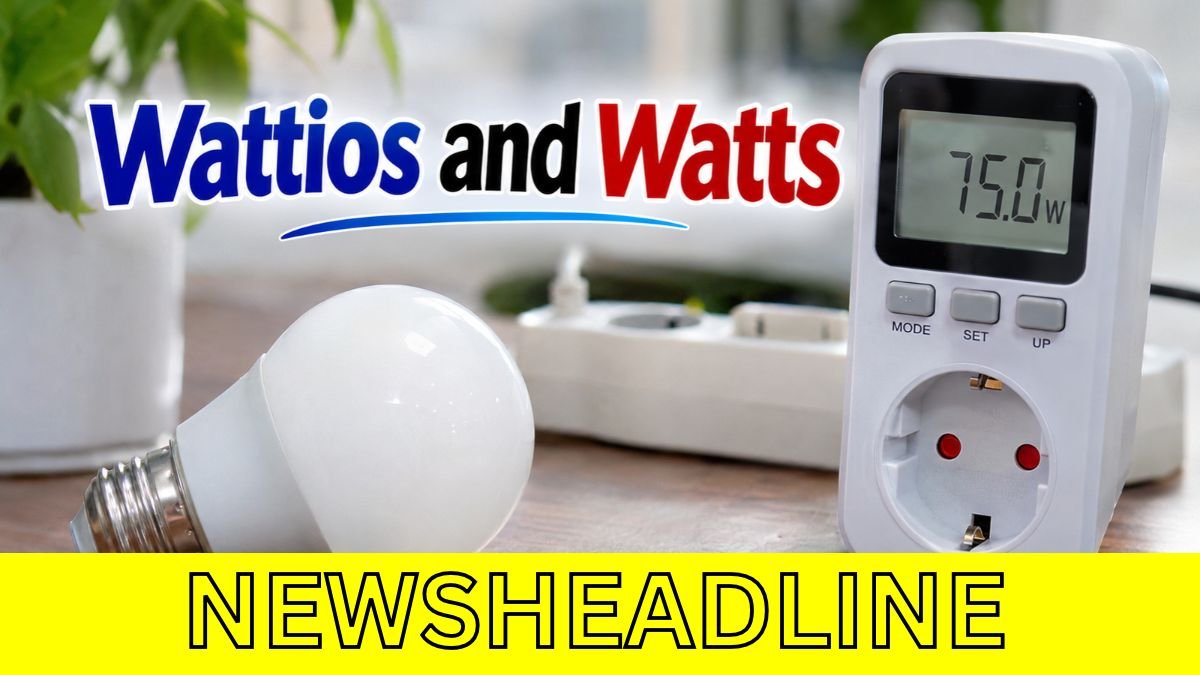
Consumers can also use compatible plug-in energy monitors to measure the consumption of suitable household devices rather than relying entirely on estimated figures.
Developing Better Energy Habits
Switching off unused equipment, selecting appropriate appliance settings and avoiding unnecessary standby consumption can help reduce electricity waste.
The financial benefits depend on individual usage patterns, equipment efficiency and electricity prices.
Conclusion
Wattios and watts connect historical scientific language with modern power measurement. Understanding watts, kilowatts, and kilowatt-hours provides valuable knowledge for interpreting electrical specifications, comparing technology, and managing energy consumption.
From household appliances to renewable energy systems, these measurements remain fundamental to everyday life. By distinguishing power from energy and considering actual operating conditions, consumers can make better-informed decisions about electricity usage, efficiency, and running costs.
(FAQs)
What does Wattios mean?
Wattios is a historically documented form associated with the watt, the internationally recognized scientific unit of power.
Are Wattios and Watts the same?
In historical electrical terminology, wattios refers to the same measurement represented by watts. It is not a separate modern SI unit.
How many watts make one kilowatt?
One kilowatt equals exactly 1,000 watts.
Does higher wattage mean higher electricity bills?
Higher power generally increases energy consumption when operating time remains the same. However, total electricity costs also depend on usage duration and electricity tariffs.
Who was the watt named after?
The watt was named after James Watt, a Scottish engineer known for his contributions to steam engine development.