


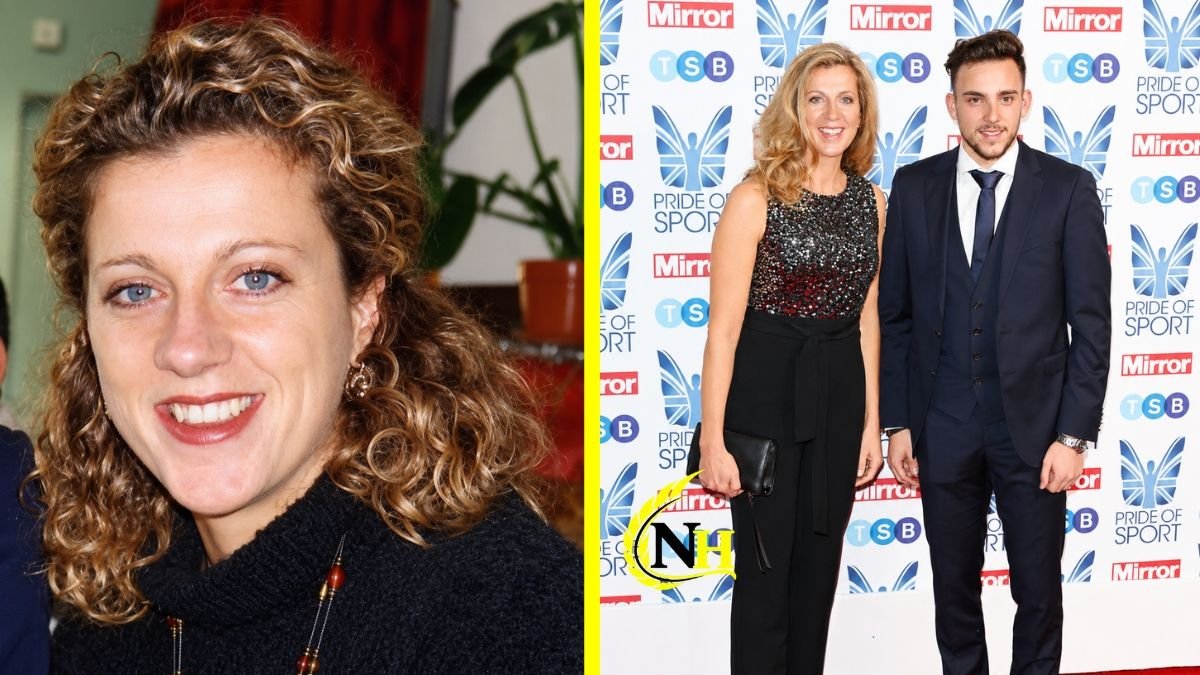
Finley Bigg is a British middle-distance athlete best known for his performances in the 400m and 800m and as the eldest son of Olympic champion Sally Gunnell and former international runner and athletics coach Jon Bigg. Born on June 2, 1998, he grew up surrounded by elite sport but developed his own competitive identity, first through football and later on the running track. His achievements include an English Schools bronze medal and an 800m personal best of 1:48.97, recorded in 2018. Although his family name draws attention, his documented performances tell a different story: that of a young runner developing his abilities in one of Britain’s most competitive sporting environments.
Early Life and Family Background
Finley Bigg was born on June 2, 1998, into a household with unusually strong connections to British athletics. His mother, Sally Gunnell, had already secured her place in sporting history, while his father, Jonathan “Jon” Bigg, brought his own experience of competitive middle-distance running and coaching.
Sally became an Olympic champion when she won the women’s 400m hurdles at the 1992 Barcelona Games. The following year, she captured the World Championships title in Stuttgart, setting a world record of 52.74 seconds. Her achievements made her one of Britain’s most successful track athletes and kept the Gunnell family name closely associated with international athletics.
Jon Bigg had competed at junior international level in the 800m before establishing himself as a coach. His professional understanding of running gave Finley direct exposure to training methods, competition preparation, and the demands of performance sport.
Growing Up with Two Athletic Parents
Finley is the eldest of three sons. His younger brothers, Luca Bigg and Marley Bigg, also grew up in a family that regarded physical activity as an ordinary part of everyday life.
In an interview with The Guardian in April 2011, Sally described how her sons participated in football, rugby and cricket. She explained that she wanted them to understand exercise as an enjoyable activity rather than simply a route to professional achievement.
That distinction would become especially important in Finley’s development. Despite their backgrounds, his parents did not insist that he become a competitive runner. Instead, they encouraged him to explore different sports and discover where his interests lay.
This approach allowed Finley to experience athletics through his own interests rather than through the expectation that he would replicate his mother’s Olympic success.
From Football to Competitive Athletics
Football initially occupied a more prominent place in Finley’s sporting life than track running.
As a teenager, he played football while also participating in rugby and other school sports. His movement towards athletics became more serious following an unsuccessful trial with Brighton’s football setup around Christmas 2013.
In an interview published by Athletics Weekly in August 2014, he said he then began focusing more heavily on running.
His athletic potential was already becoming apparent. During 2013, he recorded a 400m time of approximately 51.6 seconds and won titles at Sussex county and national independent schools level.
These early results indicated that his speed could translate into meaningful competitive performances.
The 2014 English Schools Breakthrough
One of Finley’s most significant early achievements came at the 2014 English Schools Athletics Championships.
Competing in the 400m, he recorded a personal best of 49.36 seconds and earned a bronze medal.
For a 16-year-old runner still establishing himself in the sport, the result marked an important step forward. It also showed that his commitment to athletics was growing beyond casual participation.
In its August 2014 profile, Athletics Weekly described his progress and the friendly family discussions about whether he would eventually specialize in the 400m hurdles or the 800m.
Finley himself remained open to different events, rather than committing immediately to a single discipline.
Training Under Jon Bigg
Finley’s development was closely connected to his father’s coaching expertise.
Jon Bigg was working with an accomplished training group that included middle-distance runner Charlie Grice, who became a Commonwealth Games 1500m finalist.
Training alongside more established runners exposed Finley to the endurance work required for events beyond the 400m.
His sessions included track work, field running, and winter conditioning along Brighton’s seafront. In his 2014 interview, he described the cold, windy seafront tempo sessions as among his least enjoyable workouts.
At that stage, Finley trained about five times per week.
The combination of endurance training and natural speed laid the foundation for his eventual progression toward the 800m.
Why the 800m Became Important
The transition from the 400m to the 800m is more demanding than simply doubling the race distance.
The 400m places substantial emphasis on sprint speed and the ability to maintain that speed under fatigue. The 800m requires a different balance of aerobic conditioning, speed endurance, pacing, and race judgment.
Finley’s background offered a useful combination of these qualities. His early 400m performances demonstrated speed, while his training environment exposed him to athletes specializing in longer track events.
His eventual move into the 800m therefore followed a recognizable athletic progression rather than an abrupt change of direction.
The Development of His 800m Career
By 2017, Finley had established enough credibility in middle-distance running to receive further recognition.
England Athletics selected him for an indoor competition in Bratislava, listing him in the 800m alongside fellow British athletes. The official announcement identified his club as Brighton Phoenix and his coach as Jon Bigg.
Selection for such a competition represented a meaningful step beyond domestic school-level racing. It also demonstrated that his athletic development was recognized within an established national governing-body structure.
Personal Best of 1:48.97 in 2018
Finley’s most widely documented 800m performance occurred on 8 August 2018, when he ran 1 minute 48.97 seconds in Watford, England.
The time is recorded in his official World Athletics athlete profile.
It represented an improvement after a series of races in the 1:49 range and placed him below the important 1-minute-49-second barrier.
His officially listed performances also include:
| Event | Recorded Best | Date |
|---|---|---|
| 800m outdoors | 1:48.97 | 8 August 2018 |
| 800m indoors | 1:51.59 | 16 February 2019 |
| 600m outdoors | 1:19.86 | 7 May 2017 |
| 600m indoors | 1:20.10 | 18 December 2016 |
| 400m indoors | 49.03 | 2 February 2020 |
These results demonstrate competitive experience across both sprint and middle-distance disciplines. His 2014 outdoor 400m result of 49.36 seconds should be distinguished from the later indoor 49.03-second mark.
Although Finley did not achieve the international prominence of his mother, his recorded performances establish him as a competitive athlete in his own right.
Health, Nutrition and His Publicly Discussed Dietary Experience
In 2018, Finley participated in a commercial food-intolerance testing program associated with YorkTest, a company for which Sally Gunnell was a brand ambassador.
The company published a case study describing Finley’s experiences with persistent nasal congestion and concerns about breathing comfortably during races.
The account stated that he underwent an IgG-based food-reaction test that identified responses to wheat, cow’s milk and eggs.
After dietary adjustments, Finley reported improved symptoms.
He described the change in the company’s published testimonial:
“I felt like I could actually breathe again properly.”
The case study also linked the dietary adjustment period to his subsequent 800m personal best of 1:48.97.
What the Medical Evidence Actually Establishes
It is important to distinguish Finley’s reported experience from independent clinical evidence.
His statement describes a personal perception of symptom improvement; it does not establish that particular foods caused his nasal congestion or that a commercial IgG test accurately diagnosed a food intolerance.
The NHS cautions that some commercially available home food-intolerance tests lack adequate evidence of accuracy. Similarly, the British Dietetic Association does not recommend food-specific IgG testing as a diagnostic method.
Consequently, the documented conclusion is limited: Finley reported feeling better after changing his diet, but the precise medical explanation for that improvement has not been independently established in the cited material.
This distinction matters because his experience has been presented in promotional material, where personal testimonials and medical findings require different standards of interpretation.
Relationship with Sally Gunnell
Finley’s connection with Sally Gunnell remains central to his public identity.
His mother experienced the highest levels of international athletics, including Olympic competition, world-record performances and major championship victories.
For Finley, however, her public reputation was only one aspect of their relationship.
In his 2014 interview with Athletics Weekly, he acknowledged that he respected his parents’ achievements while explaining that, in the family home, he saw them primarily as his mother and father.
The interview also described an unusual crossover between his family’s sporting prominence and his personal competition experiences: on some occasions, his mother presented medals at events in which he competed.
Rather than treating his family background as an inevitable guarantee of success, the available interviews portray a young athlete interested in finding his own competitive level.
The Influence of Jon Bigg
Jon Bigg’s role deserves equal recognition.
While Sally’s Olympic achievements provide the most obvious connection for readers, Jon was directly involved in Finley’s coaching and physical preparation.
His 800m experience was particularly relevant as Finley developed from a school-level 400m runner into a competitive middle-distance athlete.
This dual influence helps explain the range of events Finley explored early in his career. Sally brought direct sprint hurdling experience, while Jon brought specialized middle-distance knowledge.
The available evidence supports their involvement as parents and athletic mentors, without requiring assumptions about private family dynamics.
Personal Life and Public Privacy
Unlike his mother, Finley has not maintained a consistently prominent public profile through media appearances or celebrity coverage.
Most reliable information about him concerns his athletic performances, family connections, and occasional interviews.
Details of his private relationships, financial circumstances, and professional activities outside athletics are not comprehensively documented in established public sources.
No reliable source confirms an exact net worth or a romantic partner.
His relatively limited media presence should not be interpreted as evidence of a particular lifestyle or personal circumstance.
Where Is Finley Bigg Now?
As of November 2026, Finley Bigg is 28.
His World Athletics profile continues to document his competitive history, including the 2018 outdoor 800m personal best and later indoor performances. The profile also contains a season-best section for 2024.
However, available authoritative sources do not confirm a current training program, a professional coaching appointment, or an official retirement announcement.
Without further verification, it would be inaccurate to describe him definitively as either a full-time active professional runner or a retired athlete.
His documented career remains the strongest basis for evaluating his place in British athletics.
Key Takeaways: Finley Bigg Beyond His Family Name
Finley Bigg’s sporting history is best understood through his actual competitive record rather than through comparisons with his Olympic-champion mother.
His progression from football to school athletics, followed by selection for an England Athletics competition and a sub-1:49 800m performance, reflects sustained competitive development.
His story also illustrates an important distinction between inherited sporting opportunity and individual achievement. Access to knowledgeable parents and an established coaching environment can provide advantages, but recorded results must still be earned on the track.
Finley’s documented achievements deserve recognition on their own terms, without exaggerating his international standing or reducing his career to a famous surname.
Conclusion
Finley Bigg represents a distinctive chapter in a celebrated British athletics family. As the son of Sally Gunnell and Jon Bigg, he grew up close to the demands and achievements of competitive running, yet his early sporting choices were not confined to following his parents’ example.
From football to a 2014 English Schools bronze medal, and eventually to an 800m personal best of 1:48.97 in 2018, his career developed through measurable stages. His involvement in competitive athletics was supported by a substantial family sporting background, but his race results provide independent evidence of his abilities.
Although details of his current activities remain limited, the public record shows more than celebrity association alone: Finley Bigg pursued competitive athletics, achieved recognized performances, and developed his own sporting identity within a family already familiar with the highest levels of the sport.
You might also like:Diane Antonopoulos: The Private Life and Family Story of Luke Donald’s Wife
(FAQs)
1. Who is Finley Bigg?
Finley Bigg is a British athlete and the eldest son of Olympic 400m hurdles champion Sally Gunnell and athletics coach Jon Bigg. He has competed in the 400m and 800m.
2. How old is Finley Bigg?
Finley Bigg was born on June 2, 1998, making him 28 years old as of November 2026.
3. Who are Finley Bigg’s parents?
His parents are Sally Gunnell, the 1992 Olympic 400m hurdles champion, and Jonathan “Jon” Bigg, a former junior international middle-distance runner and athletics coach.
4. What is Finley Bigg’s fastest 800m time?
His officially listed outdoor 800m personal best is 1:48.97, achieved at Watford on August 8, 2018.
5. Is Finley Bigg still competing in athletics?
His competition history is publicly documented, but reliable evidence establishing his current competitive status in November 2026 is limited. No confirmed retirement date has been established from the reviewed sources.