


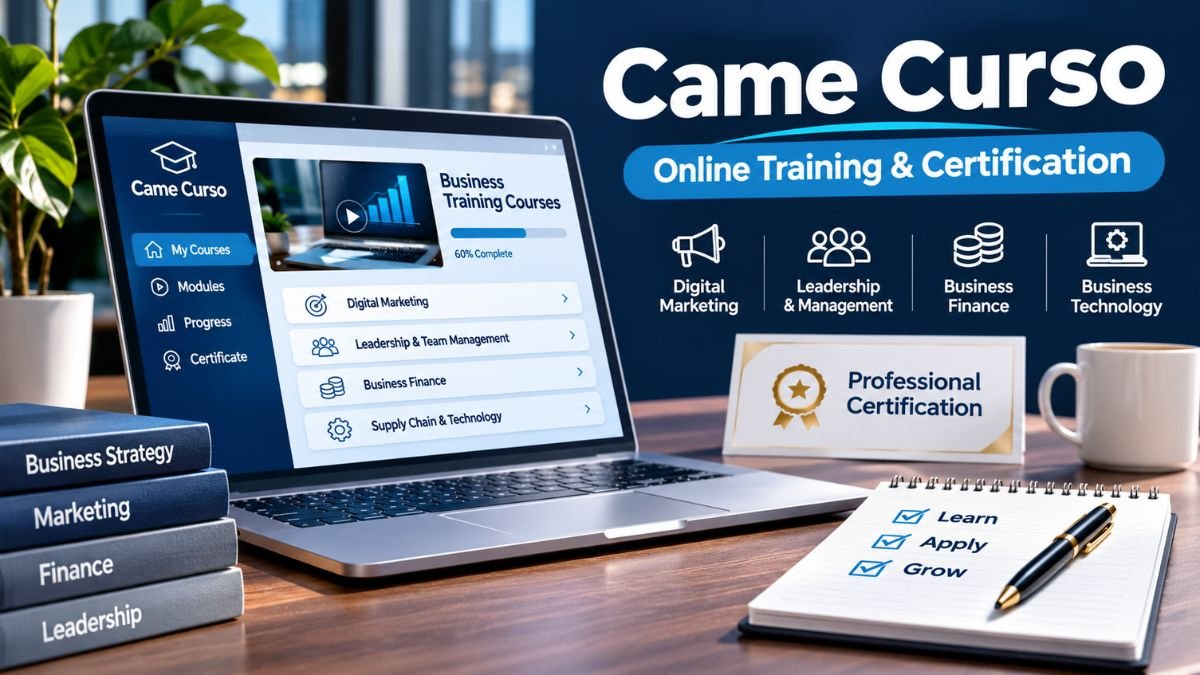
Came Curso is a search term for professional training programs offered by the Confederación Argentina de la Mediana Empresa (CAME). This organization supports small and medium-sized enterprises in Argentina. Through its business school and online learning initiatives, CAME provides education covering management, digital marketing, finance, leadership and business operations. Its training options include free introductory courses and paid advanced programs, although availability, prices and requirements vary.
For entrepreneurs, business owners, and professionals, these programs offer opportunities to build practical skills without committing to conventional full-time education.
Understanding the differences between CAME’s learning platforms is essential before choosing a course.
What Is Came Curso?
The term Came Curso generally refers to educational opportunities connected with Argentina’s CAME organization, rather than a standardized course with a fixed curriculum.
CAME represents the interests of small and medium-sized enterprises, often called SMEs or pymes in Argentina. Its educational initiatives are designed to help these businesses develop the capabilities needed for better planning, more effective operations and sustainable commercial development.
The organization’s Escuela de Negocios offers training through multiple formats, including short online courses, executive programs, specialized diplomas and professional development activities.
Academia CAME also offers advanced training focused on applying business concepts in practical situations.
A useful distinction is that enrolling in a short introductory program is different from completing an advanced professional course. The expected workload, financial commitment, assessment process and eventual qualification can differ significantly.
The name CAME can also refer to an unrelated Italian automation manufacturer that provides technical training for installers. Readers should therefore confirm the organization before registering.
The Background of CAME Business Education
Professional education has become increasingly important for smaller businesses operating with limited resources and changing market expectations.
Large companies may employ specialized financial analysts, marketing departments, and technology teams. Smaller enterprises often rely on owners or a small management group to perform several responsibilities.
This difference creates a practical training requirement.
CAME’s education initiatives address that requirement by making management and commercial knowledge available through structured learning programs.
Its business school has historically advertised approximately 60 short online courses, alongside university-certified diploma programs, executive education and shorter learning modules.
The organization also reports a quality-management framework associated with IRAM-ISO 9001:2015 standards. This institutional information provides useful background, but it should not be confused with independent academic accreditation for each course.
The broader purpose is workforce development: helping entrepreneurs and employees make better decisions using knowledge they can apply in their organizations.
Courses Available Through CAME Curso
The range of subjects offered through CAME-related education platforms reflects the different responsibilities involved in managing a business.
Digital Marketing and Artificial Intelligence
Digital marketing education is particularly relevant for companies trying to reach customers through search engines, social media, advertising and online sales channels.
Academia CAME advertises training in artificial intelligence for digital marketing and customer experience.
Its advanced marketing material also addresses tools such as automation, customer relationship management and digital performance analysis.
These subjects can help participants examine how customer inquiries become sales, where marketing resources are being spent, and which activities deserve further investment.
However, completing a course does not guarantee higher revenue. The commercial outcome depends on implementation, available resources and market conditions.
Leadership and Team Management
Leadership development is another important area.
Smaller companies often struggle when operational decisions depend entirely on one individual. Effective delegation, communication and defined responsibilities can reduce that dependency.
CAME’s advanced course catalog includes agile leadership and high-performance team management.
For participants, the practical value lies in understanding how to organize responsibilities, evaluate progress, and improve coordination between employees.
Business Finance and Strategic Planning
Financial education provides a foundation for understanding cash flow, budgeting, operational costs and business planning.
These skills can be especially useful for companies experiencing irregular sales or seasonal demand.
An advanced strategic finance program can introduce approaches to forecasting and scenario analysis, allowing business owners to evaluate different outcomes before committing resources.
Training materials should support informed decisions, not replace individualized financial advice.
Supply Chain and Business Technology
Modern businesses increasingly use digital systems to manage inventory, procurement, delivery and operational reporting.
Academia CAME’s supply-chain digitalization program discusses technologies including enterprise resource planning systems, automation, artificial intelligence and connected devices.
The value of these subjects is not simply technological familiarity.
A business must understand whether a particular system solves an existing operational problem, improves record accuracy or reduces avoidable costs.
How Online CAME Training Works
The learning experience depends on the program selected.
Academia CAME describes its advanced courses as fully online, asynchronous and supported, with an indicative workload of approximately 30 hours per course.
This arrangement lets participants study without attending every lesson at a fixed time.
An asynchronous course normally involves accessing prepared materials, completing learning activities and progressing through modules according to the program’s requirements.
CAME also offers other education formats, including scheduled virtual sessions and selected classroom-based learning.
Students should therefore examine each program description rather than assuming that every course follows the same timetable.
How to Register for CAME Courses
Registration ordinarily begins by identifying the relevant CAME learning platform and reviewing its current catalog.
Prospective students can compare program descriptions, subjects, delivery methods, fees, and assessment requirements before choosing an option.
For Academia CAME, the official guidance states that learners register through the platform’s enrolment process.
After registration is confirmed, students receive account access details by email. These credentials let them access the learning environment and begin the relevant modules.
Before paying, applicants should check whether the program has eligibility conditions, whether membership discounts apply, and whether any assessments are necessary for certification.
CAME’s business education ecosystem includes more than one platform, so registration instructions should always be confirmed on the particular course page.
Are Came Curso Programs Free?
Some CAME training opportunities are free, while others require payment.
The Escuela de Negocios has promoted free short online courses as part of its wider educational activities.
By contrast, the Academia CAME catalog reviewed in November 2026 displayed selected advanced courses priced at ARS 120,000.
Academia CAME also advertises membership benefits, including discounts for eligible CAME members.
These details demonstrate why a single price cannot accurately represent every course.
Students should verify the displayed fee, applicable discount, payment conditions, and refund policy before enrolling.
A free introductory course and a paid advanced program may address related subjects while providing different levels of instructional depth.
Certification and Professional Recognition
Certification is an important consideration for students comparing professional education options.
Academia CAME explains that its advanced programs require an integrative practical assignment before learners can receive their digital completion certificate.
The assignment must be submitted, evaluated, and approved.
Successful participants receive a certificate identifying the learner and the completed program, with institutional backing from CAME.
Nevertheless, a professional training certificate should not automatically be treated as equivalent to a university degree or a regulated professional qualification.
Some Escuela de Negocios diploma programs advertise university certification, but their conditions must be examined individually.
For employers, the most useful consideration may be whether the student can demonstrate relevant knowledge alongside the certificate itself.
The Practical Benefits of Professional Training
One advantage of Came Curso programs is their relevance to daily commercial responsibilities.
The most useful training does more than introduce business terminology. It encourages participants to evaluate real problems, identify measurable objectives and select appropriate actions.
For example, a business owner studying digital marketing might use the coursework to review advertising expenses and customer acquisition methods.
Someone attending leadership training could examine how responsibilities are distributed across employees.
A supply-chain participant might assess where inventory records and purchasing procedures need improvement.
These examples illustrate possible applications, not guaranteed results.
The long-term value of professional education depends on the learner’s ability to translate instruction into consistent practice.
Limitations to Consider Before Enrolling
Professional courses should be evaluated with the same attention as other business investments.
Course descriptions may emphasize flexibility, improved skills, or commercial benefits, but those claims do not guarantee the same result for every participant.
Students should consider their existing experience, available study time, financial circumstances and learning objectives.
A short introductory program may be sufficient for someone learning a subject for the first time. An experienced manager may need more specialized instruction.
It is also important to verify whether a qualification is relevant to a particular employer, profession or industry.
Course completion alone does not establish professional competence. Practical experience, continued learning and measurable work remain important.
Why CAME’s Training Approach Matters
CAME’s educational model highlights a broader challenge in small-business development: access to relevant management knowledge.
Businesses can purchase technology, hire consultants or adopt new software, but these investments may provide limited benefits without employees who understand how to use them.
Structured training can help bridge that gap.
For smaller enterprises, learning programs are particularly attractive when they address specific business problems and let participants keep working while studying.
The distinction between free introductory education and advanced applied training also allows learners to choose different levels of commitment.
Ultimately, assess a program’s quality by its curriculum, teaching approach, assessment requirements, and relevance to real business needs.
Conclusion
Came Curso offers a useful starting point for researching professional education opportunities associated with Argentina’s CAME organization.
Its wider training ecosystem includes accessible online education and more specialized programs covering digital marketing, management, finance, leadership, and operational technology.
The strongest reason to consider these courses is their emphasis on practical business knowledge. However, applicants should compare platforms, review certification requirements, and confirm current prices before registering.
For entrepreneurs and professionals seeking structured development, the appropriate course is the one that matches a genuine skill requirement and offers a realistic opportunity to apply what is learned.
(FAQs)
1. What is Came Curso?
Came Curso commonly refers to training programs associated with Argentina’s CAME organization, including online courses offered through its business education platforms.
2. Are CAME courses available online?
Yes. CAME offers online learning, including asynchronous advanced courses, scheduled virtual training, and other educational formats.
3. Is CAME Curso free?
Some short courses are free, while selected advanced programs charge enrolment fees. Prices depend on the course and platform.
4. Do CAME courses provide certificates?
Selected programs award certificates after participants satisfy the relevant assessment requirements. Certification conditions vary by course.
5. Who can benefit from CAME training?
Entrepreneurs, small-business owners, employees, managers, and professionals seeking improved business and technical skills may benefit.